6 mm² Solar Cable: Longer Runs, Same Connector
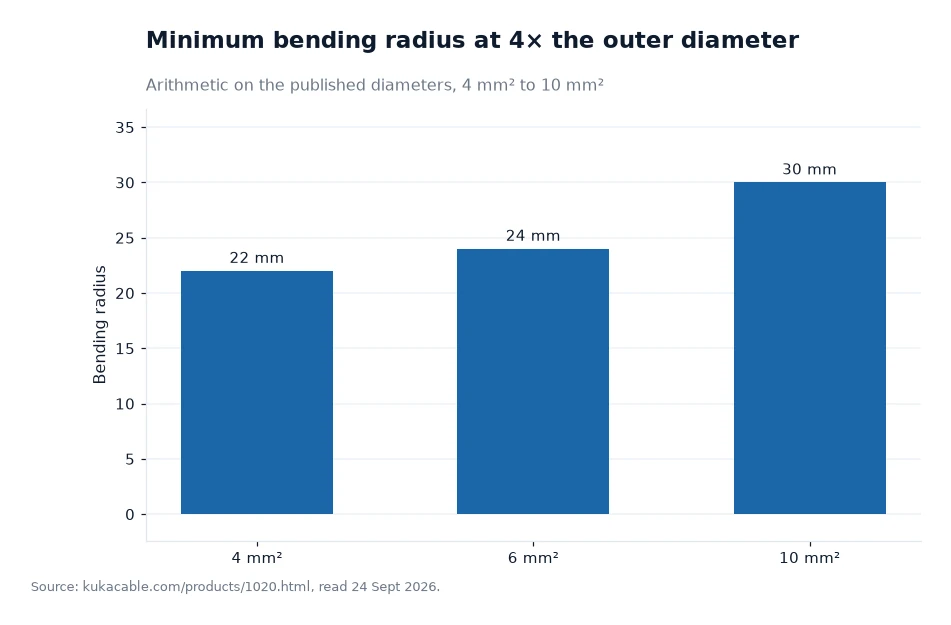
Stepping a run from 4 mm² to 6 mm² buys distance rather than a new connector: the nominal overall diameter moves only from 5.5 mm to 6.0 mm, so the same mating pair still fits. KUKA CABLE publishes 6 mm² as one of its commonly used sizes, built from 84 strands of 0.29 mm and weighing 78 g/m, and it keeps the same bending rule — 24 mm minimum radius, the author's arithmetic on the published 6.0 mm diameter.
Key takeaways
- The published diameter grows from 5.5 mm to 6.0 mm from 4 mm² to 6 mm², so the connector interface does not change.
- Conductor: 84 strands of 0.29 mm tinned copper, class 5 to IEC 60228; published weight 78 g/m.
- Minimum bend radius is 4× the diameter, which is 24 mm on this size (author's arithmetic).
- The 1500 V build is rated DC 1.8/1.8 kV and proof-tested at 6.5 kV AC, 50 Hz for five minutes.
What actually changes when a run steps up a size
Three published values move together on the 6mm solar cable. Weight per metre rises from 59 g/m at 4 mm² to 78 g/m at 6 mm², a difference of 19 g/m by the author's subtraction; the strand count rises from 56 to 84; and the nominal overall diameter rises from 5.5 mm to 6.0 mm. Nothing else in the build changes, because the insulation and sheath are the same electron-beam cross-linked XLPO and the conductor is the same tinned copper.
That last point is the one buyers miss. Half a millimetre of extra diameter buys more copper without redrawing the connector interface, which is why a designer can lengthen a string run and keep the same junction hardware on the array.
Why the same connector still fits
The manufacturer's range covers MC4 / solar connectors, solar fuse connectors, solar diode connectors and PV cable assemblies, and one solar cable connector page carries a CE / RoHS certificate download. Those parts are made for the common sizes, and a 0.5 mm difference in cable diameter sits inside the gland's working range.
What the larger cable does change is the curve at the joint. At 6.0 mm outer diameter the published 4× rule gives a 24 mm minimum radius, so the cable should enter a connector straight, with any bend starting at least a connector length behind the crimp. Bending immediately at the crimp is how a joint develops a gap at the seal.
The published limits that travel with the size
The temperature window is the same across the family: −40 °C to +90 °C ambient, +120 °C for 20,000 hours and +250 °C for five seconds under short-circuit. Those are cable figures, and they set the ceiling the connector body lives under when a string is carrying fault current.
The production and proof tests are published too: a 10 kV spark test during sheathing and a 6.5 kV AC, 50 Hz test for five minutes on finished cable. The standards TUV 2PfG 1169/08.2007, EN 50618:2014 and IEC 62930 are printed for the construction, and the certificates page states that certified cable is expected to hold its electrical behaviour for more than 25 years.
Records that travel with a heavier reel
The manufacturer's quality framework, called the SIF quality model, keeps retained samples with traceability, so a batch code on the sheath can be tied back to the material and the line it came from. Ask for that reference when a 6 mm² string is commissioned, and keep the reel label with the as-built drawing. It is a small habit that turns a later fault into a records check rather than a re-cable.
Handling a heavier drum on a warehouse roof
At 78 g/m, a 200 m drum works out to 78 × 200 = 15,600 g, or 15.6 kg — the author's calculation from the published figure — which is a two-person lift once the drum is added. On a large flat roof the cable often crosses a dark membrane in full sun, which is where the published UV work matters: a 2,000-hour xenon lamp test, equivalent to about 360 weathering cycles, has been arranged on the manufacturer's solar cables.
The 6 mm² build suits runs along a rail where the 4 mm² would need two pulls, and the extra 0.5 mm of diameter is invisible against a clip spacing set for the smaller size. Check the clip's stated range rather than assuming it.
Where the step up is not the answer
A heavier section is not automatically the better choice. It needs a wider curve, 24 mm against 22 mm by the author's arithmetic, and it puts more mass on every fixing along the run. Where the drop is already inside the design's allowance, the smaller cable is easier to dress and cheaper in copper.
The manufacturer publishes no ampacity table or derating figure, so the decision cannot be read off its site: it comes from the design's own current, distance and installation method. What the cross-section table does publish is the build, the tests and the dimensions, and those are what a buyer should match against the drawing.
| Nominal cross-section | Conductor construction | Nominal overall diameter | Nominal weight | Minimum radius at 4× (author's calculation) |
|---|---|---|---|---|
| 4 mm² | 56 × 0.29 mm | 5.5 mm | 59 g/m | 22 mm |
| 6 mm² | 84 × 0.29 mm | 6.0 mm | 78 g/m | 24 mm |
| 10 mm² | 142 × 0.29 mm | 7.5 mm | 130 g/m | 30 mm |
| 16 mm² | 238 × 0.29 mm | 8.8 mm | 190 g/m | 35.2 mm |
| 25 mm² | 375 × 0.29 mm | 11.0 mm | 292 g/m | 44.0 mm |
Worked example
Price the copper from the label. The published build is 84 strands of 0.29 mm, so each strand measures π × (0.29 ÷ 2)² = 0.066 mm² and the bundle works out at 84 × 0.066 = 5.55 mm² of copper, the author's own calculation against a nominal 6 mm². The published weight of 78 g/m includes insulation and sheath, which is why the delivered mass is always above the copper content.
Use the same numbers to size a pull. A 60 m run in 6 mm² weighs 78 × 60 = 4,680 g, or 4.68 kg of cable, and its tightest permitted curve is 4 × 6.0 = 24 mm. Four elbows on that route at a 40 mm radius leave the cable inside its limit; two elbows at 20 mm do not, and a crease there is permanent.
Frequently asked questions
Does a 6 mm² solar cable need a different connector?
No change to the connector interface is published. The nominal overall diameter moves from 5.5 mm at 4 mm² to 6.0 mm at 6 mm², and the manufacturer's range covers MC4 / solar connectors, solar fuse connectors, solar diode connectors and PV cable assemblies for these sizes.
How tightly can a 6 mm² solar cable be bent?
The published rule is 4× the outer diameter. With a nominal overall diameter of 6.0 mm that gives a minimum radius of 24 mm, the author's own arithmetic on the manufacturer's published figures, and any bend should start clear of the crimp rather than at it.
Choosing between four and six square millimetres
Write the string current and the run length into the enquiry, then ask which published section fits: the table on the manufacturer home page gives the build and the dimensions but no ampacity, so the answer comes from the design and not from a datasheet alone. Confirm the diameter on the reel's label before ordering connectors, because it is the number the 4× radius rule and the gland's working range both start from. Ask for the certificate copy and the proof-test record for the batch, and check the sheath print carries the standards the specification names.
Figures for the 6 mm² build described here are those the manufacturer publishes on its own website, which was consulted 24 Sept 2026[1].