Filtered, Unfiltered and 18+ Filters Explained
A filter does not change a character; it changes the catalogue you are allowed to see. The same card can show 24.3M views and 7.1K favourites on the trends page and still fail to appear in one of the three filter states, because the state decides which cards enter the pool long before any ranking is applied.

Key takeaways
- Three states exist — Filtered, Unfiltered and 18+ — and each one returns a different pool drawn from the same catalogue.
- Counters belong to cards, not to states: a card keeps its 24.3M views and 7.1K favourites in every scope where it can appear.
- Ratios are only comparable inside one scope. The three leading cards sit at 0.029%, 0.026% and 0.015%, averaging near 0.023%.
- Age gating runs beside filtering: the 18+ state and the site's compliance statement sit alongside the content and community guidelines.
One catalogue, three scopes
The filter row is the least glamorous control on the site and the one that changes the most. Crushon offers three states — Filtered, Unfiltered and 18+ — as scopes of a single catalogue rather than three separate products. Nothing about a character's replies, memory or wording depends on the scope you selected; what changes is the set of cards the page is willing to put in front of you.
That has a knock-on effect on every number you see. Counters attach to the card. If a card is visible under two states, its 24.3M views and 7.1K favourites travel with it, and so do the tag row — Unfiltered, Submissive, Fictional, OC, Female — and the creator credit.
What does not travel is the baseline. A ratio means little without the pool it came from. Twenty cards drawn from a narrow scope are not directly comparable with twenty cards drawn from a wide one, because both the average and the spread of the counters move with the membership of the pool.
Reading counters inside a scope
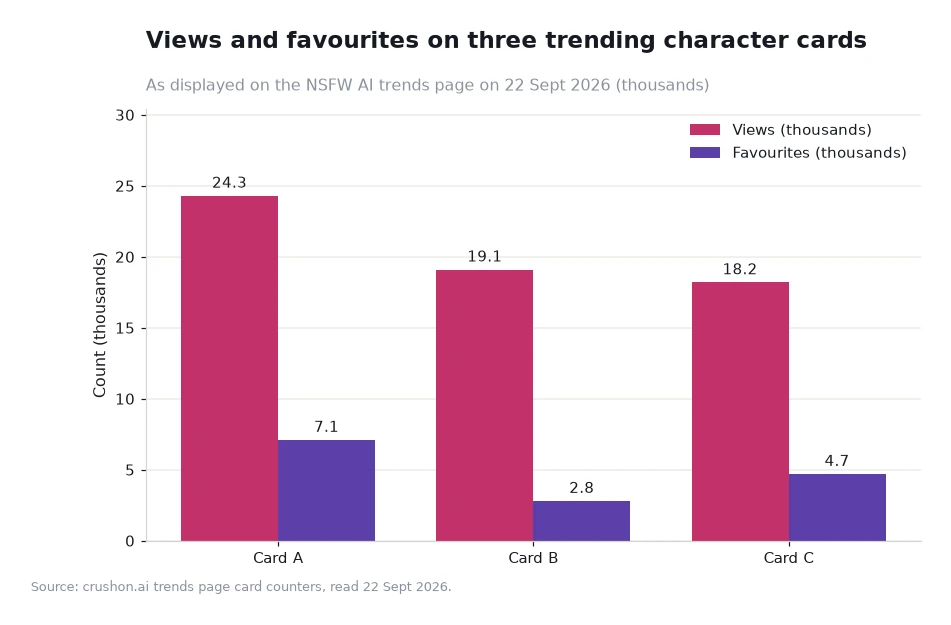
Suppose you are looking at the broadest adult scope, which is the setting the trends page assumes. Three leading cards show 24.3M views with 7.1K favourites, 19.1M with 2.8K, and 18.2M with 4.7K. Divide each pair and you get 0.029%, 0.015% and 0.026%.
In plainer terms that is roughly one deliberate save per 3,400 views on the first card, one per 3,900 on the third, and one per 6,800 on the second. The ordering by favourites therefore does not match the ordering by reach, and the ratio is what separates a card that is merely seen from one that is kept.
One further reframe is worth carrying around. A view counter describes how often a card was put in front of someone, and a favourite counter describes how often a reader decided to keep it. Neither is a rating and neither is a promise; read side by side they describe the temperature of a card's audience, which is the entire claim a trend page makes on its own behalf.
Now switch scope. The narrow state removes cards from the pool without touching any counter. If a card with a 0.015% ratio is excluded, the average of what remains rises even though no card improved. That single mechanism explains most cases where the same catalogue feels different depending on which state you left switched on.
Two habits that keep comparisons honest
First, name the scope in writing. A note as short as "unfiltered, 22 Sept, 0.023% baseline" is enough to make next month's reading comparable with this month's, and it costs a few seconds. The Thursday refresh of the weekly rankings gives you a natural point to take the reading again without changing anything else.
Second, do not compare a card found under one state with a card found under another unless you rebuild the baseline first. The temptation is strongest when a narrow scope turns up something promising, because a card that looks ordinary against a wide pool can look excellent against a thin one. The honest move is to check whether that card also appears in the wider state, and if it does, score it against the wider average.
Neither habit needs tooling beyond a text file. What they prevent is the commonest misreading in this category: treating a change in the pool as a change in the cards.
| State | Which cards can appear | What stays identical | A sensible use |
|---|---|---|---|
| Filtered | The narrower subset kept by the site's default screening | Card counters, tags and creator credit | Shorter sessions when you want less noise |
| Unfiltered | The broadest adult catalogue, including the NSFW AI characters board | The same card-level data | Comparing adult cards on even terms |
| 18+ | The adult-gated view | The same card-level data | Matching the scope to your own intent |
| Search filters | The same three states applied to a keyword or tag query | The same card-level data | Testing one tag across scopes |
Worked example: how a baseline moves
Take the three leading cards and treat the average of their ratios as the baseline for the page you are reading. The arithmetic runs 7.1K ÷ 24.3M = 0.029%, 2.8K ÷ 19.1M = 0.015%, and 4.7K ÷ 18.2M = 0.026%. Add those up — 0.070% — and divide by three to get 0.023%.
Now change the pool. Add a fourth card sitting at 18.2M views and 2.8K favourites, which is a ratio of 0.015%. The total becomes 0.085% across four cards, so the baseline falls to 0.021%. No existing card changed and no counter moved; only the membership of the comparison changed.
The lesson is bookkeeping. Whenever you write a ratio down, write the scope down beside it. Two readers can disagree about the strength of the same card without either being wrong, because they are measuring against different pools.
Switching scope without losing your thread
One habit covers most of the risk: choose the scope before you browse, and note it next to any comparison you make. The platform's nsfw ai board is built for the broadest adult scope, so a ratio taken there answers a different question from the same ratio taken in a narrow one.
Two pages make the boundaries explicit. The 2257 compliance statement describes the content as AI-generated text and states that no real person is depicted, which is the line between the adult scope and anything you might imagine it means. The character search page carries the same three states, so the scope you learn on one page transfers to the other without relearning anything.
If a card seems to have vanished, resist the urge to assume it was punished. Check the scope first; in most cases the card is still in the catalogue and simply is not part of the pool you asked for.
Frequently asked questions
Does changing the filter change how a character replies?
No. The state scopes the catalogue you browse; the character, its tags and its counters are unchanged by the setting.
Why do the same comparisons look different in another state?
Because the pool changes. A ratio of 0.029% can look strong against one baseline and ordinary against another, so record the scope alongside the number.
Where do the adult checks sit relative to filtering?
Beside them. The 18+ state is one of the three scopes, and the site's compliance statement confirms the catalogue is AI-generated text with no real person depicted.
Choose the scope first, then judge
Filtering is a decision about the question you are asking, not a judgement about the cards. Pick Filtered when you want a shorter reading list, Unfiltered when you want the whole adult catalogue on the table, and 18+ when you want the scope stated out loud. Then compare like with like, write the scope next to every ratio, and treat a change of state as a change of question rather than a change of quality.
Data and sources: the card counters and filter states shown on crushon.ai[1], read 22 Sept 2026. Ratio averages and the four-card baseline example are arithmetic on those counters. This explanation is intended for an adult readership aged 18 or over.