Building-material sourcing becomes difficult when a project brief leaves product boundaries, acceptable variation, required documents, or delivery dependencies unstated. Buyers can reduce avoidable rework by connecting each item to its intended use, technical specification, sample decision, inspection evidence, and receiving plan. The exact checks vary by material and destination, so the first task is to identify which uncertainties could change design approval, compliance, installation, or schedule.
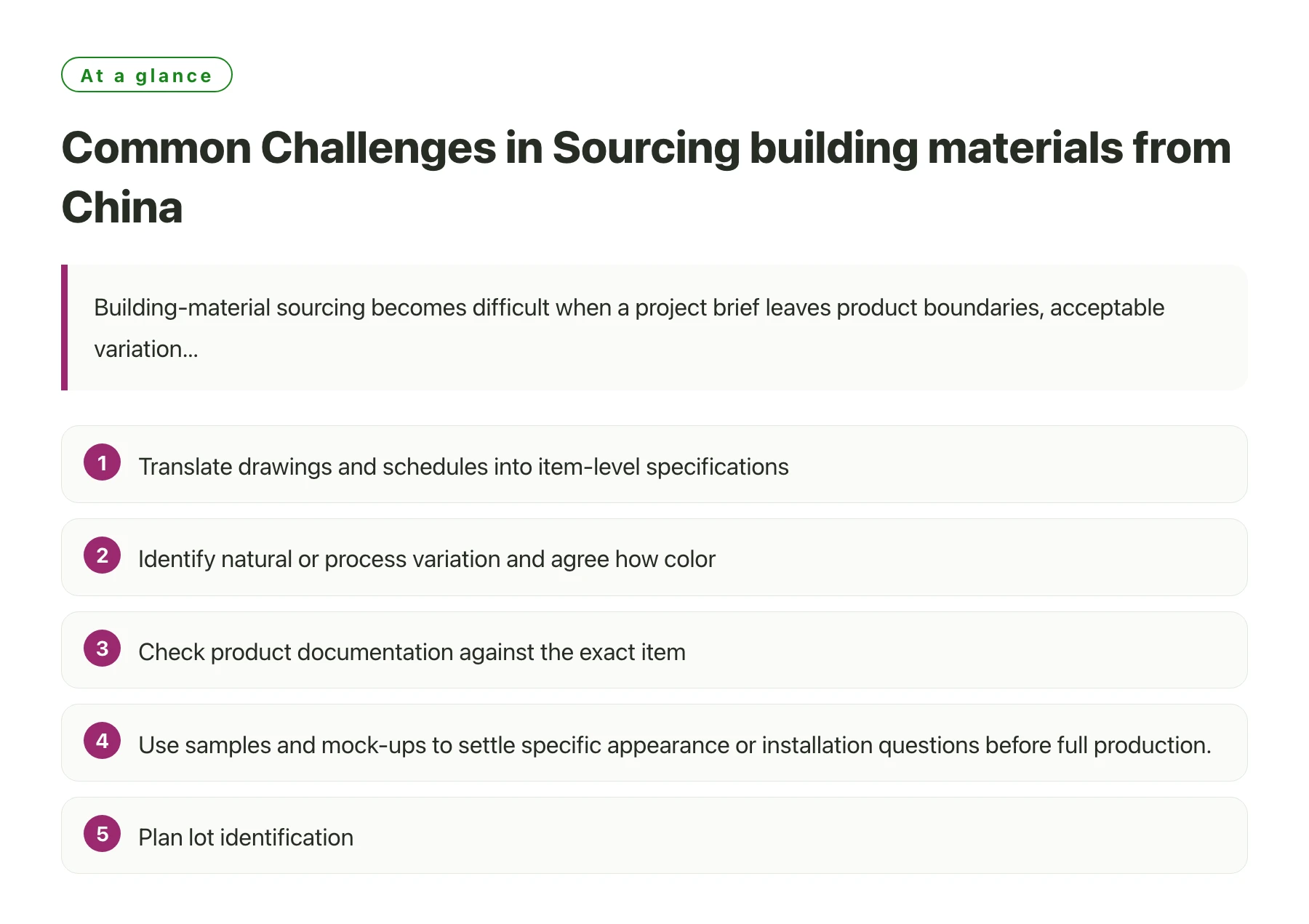
Key takeawaysTranslate drawings and schedules into item-level specifications, revisions, and measurable acceptance criteria. · Identify natural or process variation and agree how color, dimensions, finish, or batch differences will be reviewed. · Check product documentation against the exact item, manufacturer, destination, and applicable project requirement. · Use samples and mock-ups to settle specific appearance or installation questions before full production. · Plan lot identification, inspection, packing, storage, transport, and receiving as linked activities. · Assign owners and due dates to unresolved questions so they do not migrate silently into the purchase order.
A building-material order may contain products that look simple but depend on exact dimensions, finishes, substrates, installation methods, or local documentation. Problems often arise where one party assumes a value is obvious and another interprets it differently. The sourcing plan should make those assumptions visible while there is still time to revise a drawing, sample, or delivery sequence.
Challenge: the inquiry does not define the product precisely
A category name such as tile, panel, flooring, hardware, or sanitary fixture is not enough to produce a comparable quote. Identify the product code or drawing reference, dimensions, materials, finish, tolerance, color reference, intended application, quantity, packaging, and required accessories. State whether the supplier may propose an alternative and how it must show differences. If technical values are provisional, identify who will approve them and by when.
Link each line item to the drawing and schedule revision that governs it. A product can change through a finish update, revised edge, new mounting hole, or changed substrate while the commercial description stays similar. Require suppliers to quote against the same revision and return exceptions in a consistent format. This allows engineering and procurement to compare offers without having to infer what each supplier priced.
For properties that affect installation or performance, define how they will be checked. A statement such as 'premium grade' does not tell an inspector what to measure. Ask the design or engineering reviewer to identify the required test method, tolerance, certificate, or sample comparison appropriate for that product and market.
Challenge: variation is treated as a surprise
Materials and finishes may show differences between pieces or production lots. The project should decide in advance which differences are acceptable and which need action. Use reference samples and agreed viewing conditions for appearance checks; use dimensions or test results for characteristics that cannot be judged by eye. Record the approved range and identify who can accept a deviation.
When the decision depends on a shipment sample, avoid selecting only the easiest or most attractive units. ASTM's D3665 practice describes random selection of locations or timing for construction-material samples as a way to reduce unintentional sampling bias, while referring users to appropriate methods for obtaining the physical sample.[1] The applicable product method and acceptance plan still need to be chosen for the actual material and test.
Keep lot identity with inspection results. Record the production date or batch, package marks, sample source, test method, measured result, inspector, and decision. Without that connection, a useful inspection report may not establish which goods it covered.
Challenge: samples do not match the installation question
A small sample can show color or surface texture but may not demonstrate a finished corner, transition, joint, edge detail, mounting interface, or full-room appearance. Before ordering samples, state the question each one must answer. If the decision concerns how products meet at a doorway or wall, a coordinated mock-up may be more informative than isolated material chips.
Identify whether the sample uses production-intent materials, process, and finish. Label it with product, revision, date, and supplier. Record the review conditions and scope: appearance approval does not automatically verify fire performance, structural behavior, chemical composition, or compliance with destination rules. If testing is required, identify the laboratory or qualified technical reviewer and the exact sample configuration.
Plan the sample review early enough to allow correction. If the buyer changes the specification after approving a sample, state what changed and whether the old approval still applies. A controlled sample record prevents a supplier from using a prototype that was never approved for production.
Challenge: documents describe another product or market
Request documents tied to the exact item and destination: technical data, test reports, declarations, installation instructions, or other records that the project reviewer identifies. Check manufacturer name, product model, material or finish, facility where relevant, date, revision, and scope. If a report covers a product family, ask how the offered variant is included. A document for a similar-looking item may not answer the question for the one being purchased.
Make a requirements matrix with the document, owner, reviewer, due date, and status. Mark missing information as open, and distinguish it from a failed result. For regulated construction products or projects with specified standards, confirm the applicable requirements with a qualified reviewer or authority for the destination. Avoid relying on broad marketing language when the project needs evidence against a specific requirement.
Ask how a supplier will notify the buyer if a material source, manufacturing process, factory, or component changes. The change may affect a test, declaration, sample approval, or installation method, so decide whether it requires review before the new version is produced.
Challenge: production and site schedules do not align
A supplier's production lead time is only one segment of the project's delivery path. Include drawing approval, sample review, tooling or material procurement, production, inspection, packing, pickup, consolidation, transport, and site receiving. Ask which dates are estimates and which depend on a decision or booking cutoff. If different items are needed at different construction stages, plan those lots separately rather than assuming a single shipment date fits all.
Confirm how goods will be packed, labeled, protected, and identified for the receiving team. Ask for package dimensions, weights, marks, storage needs, and any unloading requirement before booking transport. Consider whether the project has room to store early deliveries safely and whether cartons need to be organized by floor, room type, or installation sequence.
When an item is late, define who may authorize a partial shipment, alternate product, or revised installation sequence. Keep a quality hold separate from a schedule exception. A product that has not passed the agreed acceptance check should not be treated as shipment-ready just because the site needs it.
Challenge: no one owns the handoff between teams
Assign a person to maintain the item register and decision log. Each open issue should have an owner, next action, due date, affected item, evidence needed, and escalation route. The project may involve a designer, contractor, supplier, buyer, inspector, freight provider, customs broker, and receiving team; the handoff record should say who is waiting for whom and what output will unblock the next step.
Before placing an order, summarize accepted deviations, final quantities, packaging, inspection points, shipping instructions, and required documents in the controlled purchase set. If sourcing coordination support is needed, review JS Sourcing against the specific supplier, sample, quality, and delivery tasks. Keep final design approval, regulatory determination, and project acceptance with the people assigned those responsibilities.
Sources
Frequently asked questions
What is the most common reason a building-material quote cannot be compared?
Suppliers may quote different dimensions, materials, finishes, accessories, tests, packaging, or delivery scope. Use one controlled specification and ask each supplier to list deviations and exclusions.
Can a sample represent the full production lot?
A sample provides evidence about the selected unit or units under the review method. It does not by itself prove that every unit in a lot is identical; use production controls and an appropriate inspection plan as needed.
Should a buyer accept a supplier's alternative material?
Review its effect on design, technical requirements, installation, documentation, cost, schedule, and maintenance. Record the decision against the correct product revision before production uses the alternative.
When should inspection requirements be agreed?
Before production begins. Define what is checked, the sample method, acceptance limits, records, hold points, and how a failed result is handled.