A first order with a new perfume factory is not an inspection you pass or fail; it is a live test of how the factory runs a project you have never run together. Established beauty brands get the most out of it by walking the order in the same sequence the factory will: brief and costing, sample and approval, materials and packaging, filling and assembly, then release documents. Each stage asks a different question, and the answers only mean something when they are read in order. This walkthrough is the sequence we would follow, with the signal to watch at each step.
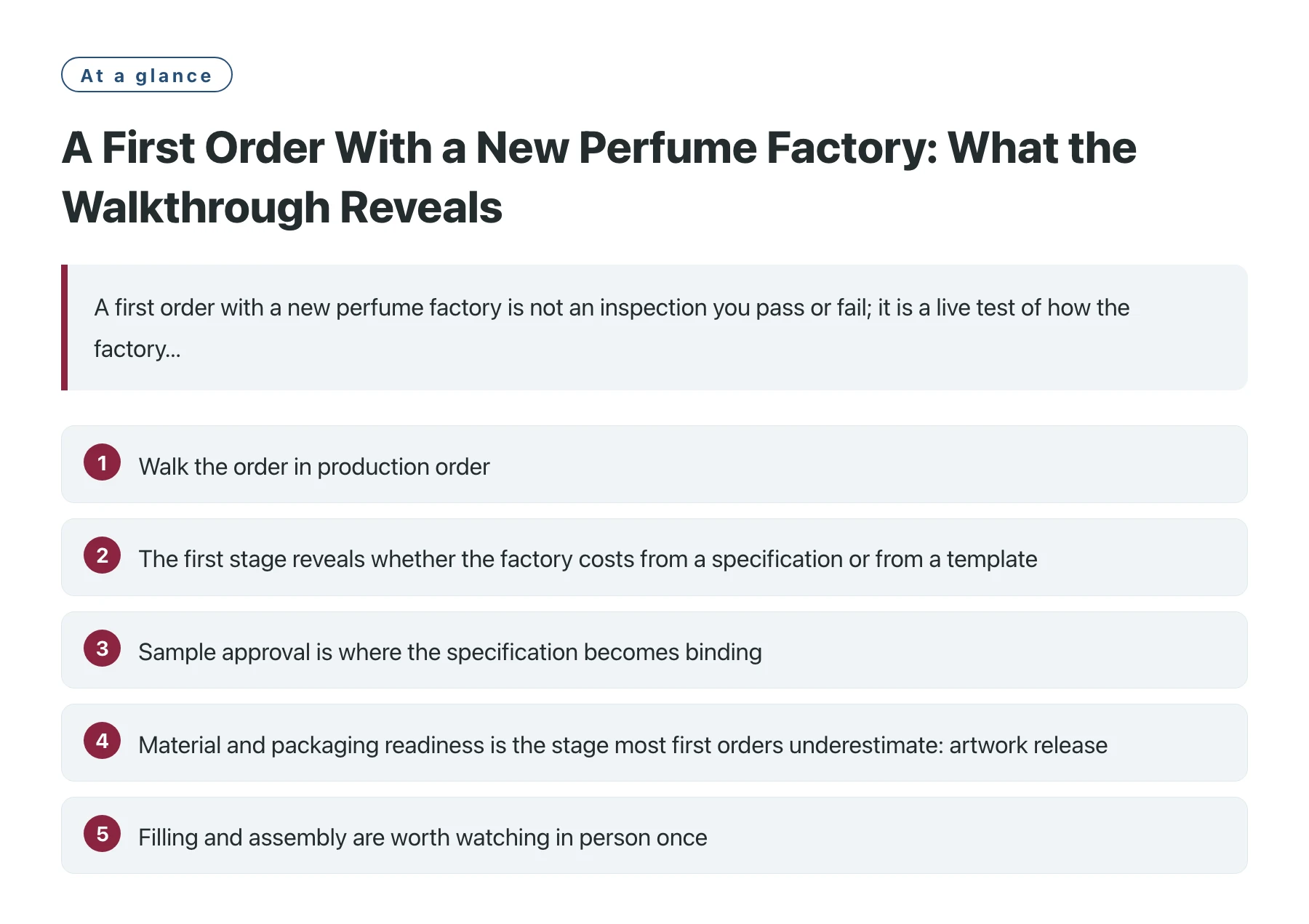
Key takeaways
- Walk the order in production order, not in the order the supplier's presentation happens to follow; a first order is easier to audit when each question sits next to the step it governs.
- The first stage reveals whether the factory costs from a specification or from a template, and a template costing is the most common reason a first order drifts from budget before a single bottle is filled.
- Sample approval is where the specification becomes binding, so the approval record should name the dosage, the reference standard and the packaging components the sample was filled in.
- Material and packaging readiness is the stage most first orders underestimate: artwork release, mould or tooling availability, and the decoration lead time sit between an approved sample and a filled bottle. [1]
- Filling and assembly are worth watching in person once, because fill-weight checks, crimp settings and line clearance are easier to confirm by observation than by conversation.
- Release documents close the loop: batch record, fill-weight record, inspection report and retention sample note are what turn a first delivery into a repeatable relationship.
New supplier onboarding is often treated as a paperwork exercise that ends when the purchase order is issued. In practice the first order is the only cheap opportunity to see the whole process while both sides are still building habits.
What follows assumes the brand already has a shortlist and a completed brief. The walkthrough is about how to spend the first order well, whether or not you can be on site, and which observations are worth recording while they are still fresh.
Five stages, in the order the factory will run them
- Stage 1 - Brief and costingSend the brief as a specification with a dosage direction, a base type, a packaging concept and a target market. Compare the returned costing line by line against it. If juice, bottle, pump, decoration, filling and freight appear as one number, the factory has not costed your product.
- Stage 2 - Sample and approvalRecord what was approved, in what packaging, at what dosage, against which reference. This is the document every later dispute will refer back to, so it should be signed by both sides rather than exchanged by email.
- Stage 3 - Materials and packagingConfirm availability before approving the sample if possible. Tooling or mould lead times, decoration capacity and artwork release dates decide the calendar far more often than the fragrance itself. [1]
- Stage 4 - Filling and assemblyAsk for the fill-weight tolerance, the check interval and the crimp specification. Watching one run, or receiving the check record from one, tells you more about consistency than any brochure. Third-party testing and inspection providers can carry part of that verification for a first order. [2]
- Stage 5 - Release and shipmentCollect the batch record, inspection report, fill-weight log and retention sample note. Ask how the factory stores its retention sample and for how long, because that decides whether a problem discovered at retail can be investigated at all.
What to record during the first order
Keep a single running log with a row per stage, the name of the person who owned it, the document received and the date. On the second order, the same log becomes a comparison: the same stages should recur with shorter lead times, and any stage that vanished has usually been absorbed rather than eliminated.
Record the questions the factory asked you, not only the ones you asked it. Factories that ask about artwork release, fill weight and packaging compatibility on a first order are showing that their process expects those answers; a factory that asks nothing and promises everything is leaving the specification to you.
It also helps to note where the factory deferred. A supplier that says a packaging component is outside its scope has drawn a boundary you can plan around.
First-order signals and what to do with them
| Stage | Signal worth recording | Action if it is missing |
|---|---|---|
| Costing | Line items match the brief | Request a re-cost against the specification before approving |
| Sampling | Approval names dosage, reference and pack | Do not release artwork until the record is signed by both sides |
| Materials | Availability confirmed with a date | Move the launch date before the tooling is committed |
| Filling | Tolerance and check interval stated | Ask for the first run's fill-weight log before shipment |
| Decoration | Limit sample signed by both sides | Inspect the first carton against it at the factory |
| Release | Batch record and inspection report in hand | Withhold final payment until the documents arrive |
| Retention | Storage location and retention period known | Confirm in writing before the second order |
Read the table as a sequence rather than a scorecard: a missing item at an early stage usually explains a problem at a later one, and the fix is normally a document rather than a different supplier. If you are unsure which questions belong at which stage, compare your log with the questions to ask a perfume factory before the review meeting.
If travel is possible, use the first order to walk the actual route of the goods - incoming warehouse, compounding, filling, decoration, packing - and ask what happens to a batch that fails a check at each point. The answer describes the quality system far more accurately than a certificate. It also helps to see how a perfume factory in China presents its own production scope, and to read its background and certifications alongside it, because a scope statement plus a document list gives you the checklist the visit is meant to verify.
The conversation that should happen before the second order
Book a short review after the first delivery, before the second order is placed, and bring the log. Three questions are enough: which stage took longer than quoted and why, which document arrived late and what caused it, and what the factory would change in the brief next time. A supplier that answers those specifically is turning the first order into process knowledge.
The same review is the moment to revisit commercial terms. First orders often carry setup, artwork or tooling costs that do not repeat, so the second order should be quoted against the settled specification rather than the first estimate. Asking how those one-off items are tracked is a quick way to check whether the factory's costing has a memory.
Finally, decide which parts of the process the brand will keep watching and which it will now trust. Supervision that does not decrease over time is a sign the process was never documented, and the fix belongs in the specification rather than in another inspection.
The release documents also define what the brand can claim about the goods. Which requirements apply to your product category in your destination market is a market-specific question, and it belongs in the first-order review rather than in a launch checklist written later. [3]
Sources
- IFRA Standards Library (International Fragrance Association) —— The IFRA Standards Library lists the restrictions the fragrance industry applies to individual fragrance ingredients, based on safety assessments; it is the reference point for compliant fragrance formulation.
- SGS: Cosmetics, Personal Care & Household Testing —— Testing, inspection and certification services for cosmetics and personal care, including microbiological, stability and safety testing aligned with cosmetics GMP.
- European Commission: Cosmetic Products — Specific Topics —— EU pages covering specific cosmetics topics such as product claims, nanomaterials and animal-testing rules.
Frequently asked questions
What should a brand check on its very first order from a new perfume factory?
Walk it in production order: costing against the brief, the signed sample approval record, material and packaging availability, the fill-weight and crimp specification, and the release documents. Each stage produces a document, and the set of documents is what makes the second order predictable.
Is a first order the right time to negotiate price?
Price is best settled once the specification is fixed, because a first quote is often built on assumptions. Negotiate a scope and a costing structure at the start, with one-off costs identified separately, and revisit the unit price against the settled specification rather than haggling over an estimate.
How much supervision does a first order need?
More than later ones, and it should taper. Watch the first filling run, approve a decoration limit sample, and collect every release document. If a second order needs the same level of supervision, the specification or the batch documentation is doing too little of the work.
What if we cannot visit the factory for the first order?
Ask for the same records you would look at on site: the fill-weight log, the crimp setting, the inspection report and photographs of the limit sample next to the finished goods. Remote verification is weaker but still workable when the document set is agreed in advance.
Which first-order document matters most?
The signed sample approval record, because it defines the specification the rest of the order is measured against. Everything else - fill weight, decoration, labelling, the retention sample - is a check against that record, so a vague approval makes every later check arguable.