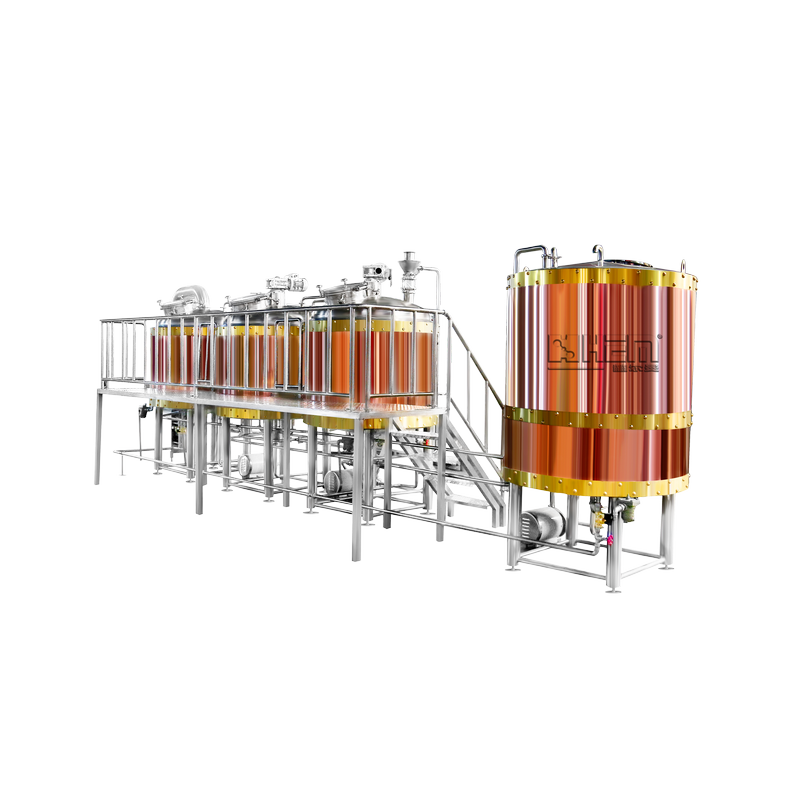
Craft beer equipment helps a new brewery control batch size, fermentation, cooling, cleaning, packaging, and labor from the first production run. A 10-barrel brewhouse produces about 310 US gallons, or 1,173 liters, before process losses, while brewhouse efficiency commonly falls around 70–85% depending on milling, mash design, lautering, and operator practice. Fermentation may occupy a tank for 7–21 days, so tank capacity often limits monthly output before the brewhouse does. Equipment selection also affects water use, energy demand, beer loss, dissolved oxygen, cleaning time, and packaging speed. A properly sized system makes production easier to repeat and easier to expand.
A brewery should begin equipment planning with annual sales volume rather than vessel size. If projected sales are 1,500 barrels per year, average monthly production is about 125 barrels before seasonal changes, maintenance days, product loss, or unsold stock are considered. A 10-barrel brewhouse used three times per week can theoretically produce 1,500 barrels in 50 brewing weeks, but fermentation space must be able to receive that beer.
That calculation leads immediately to tank planning. Ten 10-barrel fermenters provide 100 barrels of nominal fermentation space, yet usable annual capacity depends on how long each beer remains inside the vessel. An ale released after 14 days can cycle roughly twice as often as a lager occupying a vessel for 28 days, even though both tanks have the same stainless-steel volume.
Tank count should be calculated from beer residence time, not from the number of brew days. A brewery producing four batches per week can fill fermentation space faster than expected when several beers require three or four weeks before packaging.
For many small breweries, fermenters are therefore purchased in larger sizes than a single brew batch. A 20-barrel fermenter paired with a 10-barrel brewhouse allows two consecutive brews to fill one vessel. The arrangement reduces the number of tanks needed per 20 barrels of beer, although it also requires two consistent batches, adequate cooling capacity, and enough working hours to complete both brews.
The brewhouse then needs to match that schedule. A two-vessel system combines several hot-side operations and generally requires less floor space, while three- or four-vessel systems can overlap mashing, lautering, boiling, and whirlpool work. When a brewery expects only four or five brews per week, paying for equipment intended for three or more brews per day may leave much of the installed capacity unused.
| Equipment area | Practical planning figure | Why it matters |
|---|---|---|
| 10 bbl brewhouse | About 310 gal / 1,173 L | Defines nominal batch volume |
| Brewhouse efficiency | Often 70–85% | Affects malt use and wort yield |
| Ale tank occupancy | Often 10–21 days | Sets fermenter turnover |
| Lager occupancy | Commonly 3–6 weeks | Requires more tank time |
| Packaged beer DO | Often targeted below 50 ppb | Supports flavor stability |
Once brewhouse size is set, wort transfer and cooling need equal attention. Wort may leave the kettle near 100°C or 212°F and must be brought rapidly into a suitable yeast-pitching range. A plate heat exchanger sized for the actual flow rate can shorten transfer time, while an undersized unit can turn a planned 45-minute transfer into a much longer production step.
Cooling continues after yeast is pitched. Fermentation generates heat, so jacketed tanks rely on chilled glycol circulating through dedicated zones. A brewery adding four fermenters later may increase refrigeration demand by well over 20% during periods when several tanks are fermenting or crash-cooling at the same time.
The glycol system should therefore be sized around simultaneous demand rather than the temperature requirement of one vessel. Long piping runs, warm ambient conditions, poorly insulated lines, frequent cold crashes, and extra bright tanks all increase refrigeration work. Leaving connection points for future vessels is usually less disruptive than replacing the entire glycol distribution system after expansion.
A tank can have excellent fabrication and still perform poorly when its cooling jacket receives insufficient glycol flow. Tank specifications and refrigeration specifications need to be reviewed together.
Sanitary design comes next because a brewery repeatedly moves nutrient-rich wort and beer through tanks, valves, hoses, pumps, and fittings. Stainless steel is widely used because it tolerates brewery cleaning routines and can be fabricated with smooth product-contact surfaces. Poorly finished welds, dead legs, difficult-to-drain fittings, and badly placed ports increase cleaning time and leave more areas where residue can remain.
A clean-in-place arrangement reduces dismantling between batches. Typical brewery cleaning may use alkaline solutions around 1–2% concentration, followed by rinsing and an appropriate sanitizing step according to the chemical supplier's instructions. Concentration, contact time, temperature, flow, and soil level all affect cleaning performance; increasing only one variable does not compensate for poor mechanical circulation.
Water use is another equipment-related cost. Older or poorly managed breweries can consume several units of water for every unit of packaged beer, while better-designed operations reduce unnecessary rinsing, leaking, and cleaning water. Cutting total water use from 7:1 to 5:1 lowers consumption by about 29% for the same packaged beer volume.
Lower water use also reduces the amount of wastewater requiring handling. Brewery wastewater can contain yeast, sugars, cleaning chemicals, and suspended solids, so floor drains, trench placement, tank drainage, and local discharge requirements should be reviewed before tanks are installed. Moving a drain after a 30-barrel vessel is in place is far more difficult than adjusting the floor plan beforehand.
Beer loss deserves similar measurement. If a brewery produces 2,000 barrels but loses 8% between wort production, fermentation, transfer, filtration, and packaging, 160 barrels never become saleable product. Reducing total loss to 5% returns 60 barrels without adding another brew cycle.
Loss can occur through several small routes:
-
wort left below vessel outlets;
-
excessive trub removal;
-
beer remaining in hoses and transfer lines;
-
dry-hop absorption;
-
foaming during kegging or can filling;
-
inaccurate fill levels;
-
beer discarded during poorly planned changeovers.
Equipment cannot remove every loss, but vessel geometry, transfer layout, pump control, hose length, packaging adjustment, and operator access affect how much product is recovered. At 20 batches per month, even a 2% improvement becomes significant when repeated over a full year.
Packaging deserves particular attention because the beer has already consumed malt, hops, yeast, utilities, labor, and tank time before it reaches the filler. Oxygen introduced at this stage can shorten flavor stability, especially in hop-forward beers. Many breweries therefore work toward packaged dissolved oxygen levels below roughly 50 parts per billion, with tighter internal targets where equipment and process control allow.
A taproom-focused brewery may start with kegs because the filling equipment is simpler and package inventory is lower. A brewery supplying retailers may require cans, labels or printed cans, date coding, rinse systems, conveyors, seam inspection tools, and cold storage. A canning line rated at 40 cans per minute can theoretically fill 2,400 cans per hour, but changeovers, cleaning, quality checks, and beer supply reduce sustained output.
That production pattern also affects staffing. A manual or semi-automatic system may be suitable when a brewery fills cans one or two days per week, while higher volumes can support automated depalletizing, filling, seaming, labeling, and packing. Automation should be compared with actual annual operating hours rather than maximum machine speed.
The same approach applies when sourcing tanks and brewhouse equipment from suppliers such as hem brewing. Buyers should compare working volume, total volume, stainless-steel grade, internal finish, weld quality, pressure rating, cooling-jacket area, port layout, valve specification, insulation, controller compatibility, and spare-part availability rather than comparing quoted vessel capacity alone.
A 20-barrel fermenter, for example, should not be assessed only as “20 barrels.” Headspace is required during fermentation, and dry-hopped beers may need additional working allowance. A tank with 20 barrels of nominal total volume may not provide the same usable fermentation capacity as a vessel designed with enough freeboard above its stated working volume.
Factory documentation also matters. Dimensioned drawings should show tank height, diameter, leg spacing, service connections, manway position, glycol ports, sample valves, CIP connections, and clearance requirements. In a brewery with a 12-foot ceiling, a vessel that measures 11 feet before installation may still be unsuitable when lifting clearance and fittings are included.
Utility specifications need the same level of checking. A brewery should confirm electrical voltage and phase, heating power, steam requirements if used, incoming water pressure, hot-water capacity, glycol supply, compressed air, CO₂ distribution, floor drainage, and ventilation. Equipment ordered before utility capacity is reviewed can require costly building work after delivery.
CO₂ deserves specific engineering attention because fermentation and beer service can release large quantities of gas. Occupational exposure guidance uses concentration limits measured in parts per million, and enclosed cellars require ventilation and appropriate monitoring. A leak that does not damage equipment can still create unsafe working conditions, so gas detection should be treated as part of the facility layout rather than an optional tank accessory.
Expansion planning should focus on infrastructure that is difficult to change later. Additional fermenters are relatively modular, but electrical service, drainage, steam supply, refrigeration piping, ceiling clearance, and cold-room size are harder to modify once production starts. Reserving space for four future tanks can cost little during layout work while preventing major rearrangement several years later.
Industry conditions also support conservative capacity planning. U.S. craft production fell 4% in 2025, while 39% of breweries still reported production growth; performance differed widely among individual businesses rather than moving in one direction across the market. Buying equipment for a realistic sales schedule is therefore safer than assuming unused tank volume will soon be filled.
The Brewers Association also reported 9,578 operating U.S. craft breweries in 2025, down 2.9% from 2024, with craft beer representing 13.4% of total U.S. beer volume. A new brewery enters a market with thousands of established producers, so lower production cost, repeatable beer, reliable packaging, and sensible equipment utilization matter more than owning the largest available brewhouse.
Before placing an order, founders can model three production levels: expected sales, roughly 20% below plan, and roughly 20% above plan. If the same brewhouse remains workable in all three cases while fermentation tanks can be added gradually, the equipment layout has more flexibility without tying excessive capital to unused stainless steel.